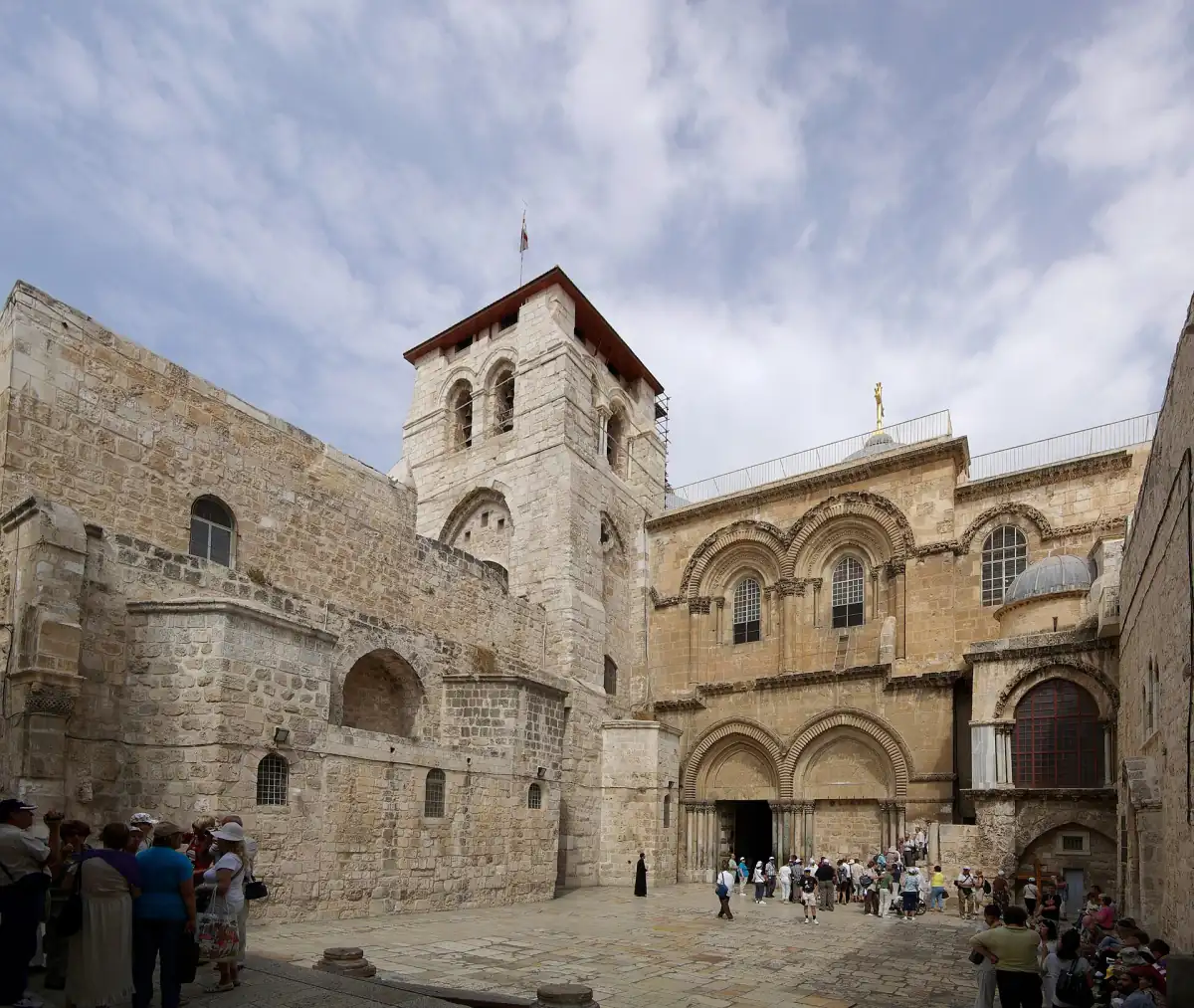
The Church of the Holy Sepulchre as a place of worship
The Church of the Holy Sepulchre stands in Jerusalem’s Old City and brings together the places venerated in Christian tradition as Golgotha, or Calvary, and the tomb of Jesus. That religious meaning is central to understanding a visit. It is also important to distinguish the tradition associated with a place from the dates and phases of the building visible today.
Allow the church to be a destination in its own right rather than a hurried stop between other landmarks. A guided city route can help with the wider setting, while time inside calls for consideration towards worshippers and other pilgrims. Choose whether the day’s main purpose is pilgrimage, church history or a broader introduction to the Old City.

Christian tradition and church history
The Custodia’s historical account dates the formal dedication of the Constantinian complex to 13 September 335 and describes later destruction and rebuilding. This date does not mean that every wall, roof or interior feature now seen belongs unchanged to that first church. Looking at the present building as a layered place is more useful than assigning its entire appearance to a single year.
Catholic Franciscans, Greek Orthodox and Armenian Apostolic communities share care or ownership responsibilities. For visitors, the church’s living religious use matters as much as its architectural interest. The Jerusalem history guide places church building history alongside other visible historic sites without turning religious tradition into an archaeological claim.
Guided visit to the Holy Sepulchre
This tour connects the church and the Western Wall with a guide and hotel pickup.
Hand-picked tours, booked through Viator. Prices are indicative starting prices in US dollars (as of November 2026). Tap a tour for live availability and the current price in your currency.

A city visit including the Holy Sepulchre
The guided Jerusalem outing visits the Holy Sepulchre and Western Wall, with hotel pickup, an air-conditioned vehicle and entrance fees as part of its city-tour package.
Published visiting hours
The Christian Information Center’s schedule dated 15 September 2026 gives regular summer hours of 05:00 to 20:45 and winter hours of 04:00 to 19:00. It lists closing at 20:00 in October and 19:30 in March. Treat these as the published church schedule, not a guarantee of admission at a particular time on your travel date.
The same information gives an 08:00 opening on Christmas and 2 February, with Holy Week requiring separate attention. If a service or a particular part of the church is important to the visit, obtain the relevant arrangements for that date. Leave flexibility afterwards rather than attaching a fixed appointment immediately to the expected end of your church visit.
Worship and dress
Church visitor guidance calls for modest clothing and respect for the sanctuaries as places of prayer. Arrange the day so that a pause for worship or quiet observation fits naturally, instead of treating other people’s religious activity as an obstacle to a sightseeing schedule. Follow instructions on movement and conduct given at the church.
Professional filming and photographic productions have a separate permissions process. Those production arrangements should not be read as an admission charge for an ordinary church visitor or as a blanket rule banning every private souvenir photograph. If the purpose of the visit is a production project, organise the dedicated permissions rather than relying on the terms of a sightseeing tour.
A route from the Old City
A published tourism-ministry walk begins at Jaffa Gate and connects David Street market, Muristan, the Holy Sepulchre, the Cardo, the Jewish Quarter and the Western Wall before returning to Jaffa Gate. It offers a useful geographical framework, not a single operating schedule for every place along the way. The Old City tour guide helps distinguish a broad introductory walk from a visit focused on one sacred site.
The Via Dolorosa is the traditional Christian processional route towards the church. Its route and the choice between a Jerusalem walk and a Bethlehem combination are covered in the Christian tours guide. Keep that larger route choice separate from how much time you want in the church itself.
Choosing a guided visit
The featured city tour combines the Holy Sepulchre with the Western Wall. Its inclusions cover a professional guide, entrance fees, an air-conditioned vehicle and hotel pickup. This is a city-tour package, not a standalone church admission product. Match it to the wish for a wider introduction rather than interpreting the tour price as the church’s own tariff.
If you also plan the Western Wall, prepare separately for its prayer-plaza etiquette and Shabbat rules. For transport and the journey back to your accommodation, use the arrival and local transport guide. Planning those connections in advance leaves the church visit less dependent on a tightly packed chain of stops.
Questions about the church
What does the date 335 refer to?
It refers to the dedication of the Constantinian church complex. Later destruction and rebuilding mean it should not be applied to every part of today’s building.
Are the published hours current admission guarantees?
They are church visiting hours from a schedule dated 15 September 2026. Use the arrangements for your travel date, particularly around Holy Week and special observances.
Is the guided offer a church ticket?
It is a guided Jerusalem city visit combining the Holy Sepulchre and Western Wall, with vehicle transport and hotel pickup among its inclusions. Its price is for that package.